
Sustainability is no longer a peripheral consideration for businesses. It is becoming a defining factor in how products are built, how companies grow, and how markets evolve. At its core, sustainability asks a simple yet demanding question: how can businesses create value today without compromising their ability to do so tomorrow?
For many companies, the conversation starts too late in the process. Sustainability is often treated as an add-on, addressed through packaging changes, offset programs, or end-of-life recycling. While these efforts have value, they rarely address the root of the challenge. The most important decisions about a product’s impact are made much earlier, at the design stage.
This is where circularity becomes essential.

A circular approach challenges the traditional linear model of “take, make, dispose” by designing products and systems that minimize waste, extend usage, and recover value over time. Embedding circularity at the product design stage means thinking deliberately about materials, production processes, user behavior, and what happens after the product has served its initial purpose.
When this thinking is integrated early, businesses position themselves differently. Material choices influence not just environmental footprint, but durability, repairability, and reuse potential. Design decisions, such as modularity or ease of disassembly, determine whether a product can evolve, be repaired, or feed back into the value chain rather than become waste. These are not decisions that can be easily retrofitted later; they define the business’s long-term efficiency and resilience.
Circular design also reshapes how value is created and captured. Businesses begin to move beyond one-time transactions toward models that extend product life, refurbishment, reuse, or service-based offerings. This opens up multiple revenue streams across the value chain while strengthening customer relationships and improving resource efficiency.
There is also a shifting expectation across markets. Consumers, investors, and regulators are increasingly attentive to how products are made and what happens to them after use. Businesses that embed circularity from the outset are better prepared to respond not through reactive compliance, but through intentional design that aligns with emerging market realities.
For early-stage businesses, this is particularly critical. The foundation built in the early phases determines the ease or difficulty of scaling. A product designed without circular thinking may gain initial traction but encounter constraints as it grows, such as rising costs, supply chain pressures, or regulatory challenges. In contrast, businesses that integrate circularity early build systems that are more adaptable, efficient, and aligned with long-term sustainability goals.
Sustainability, approached through circularity, moves beyond minimizing harm. It becomes a way of designing businesses that are inherently more resilient, more efficient, and better positioned for future markets.
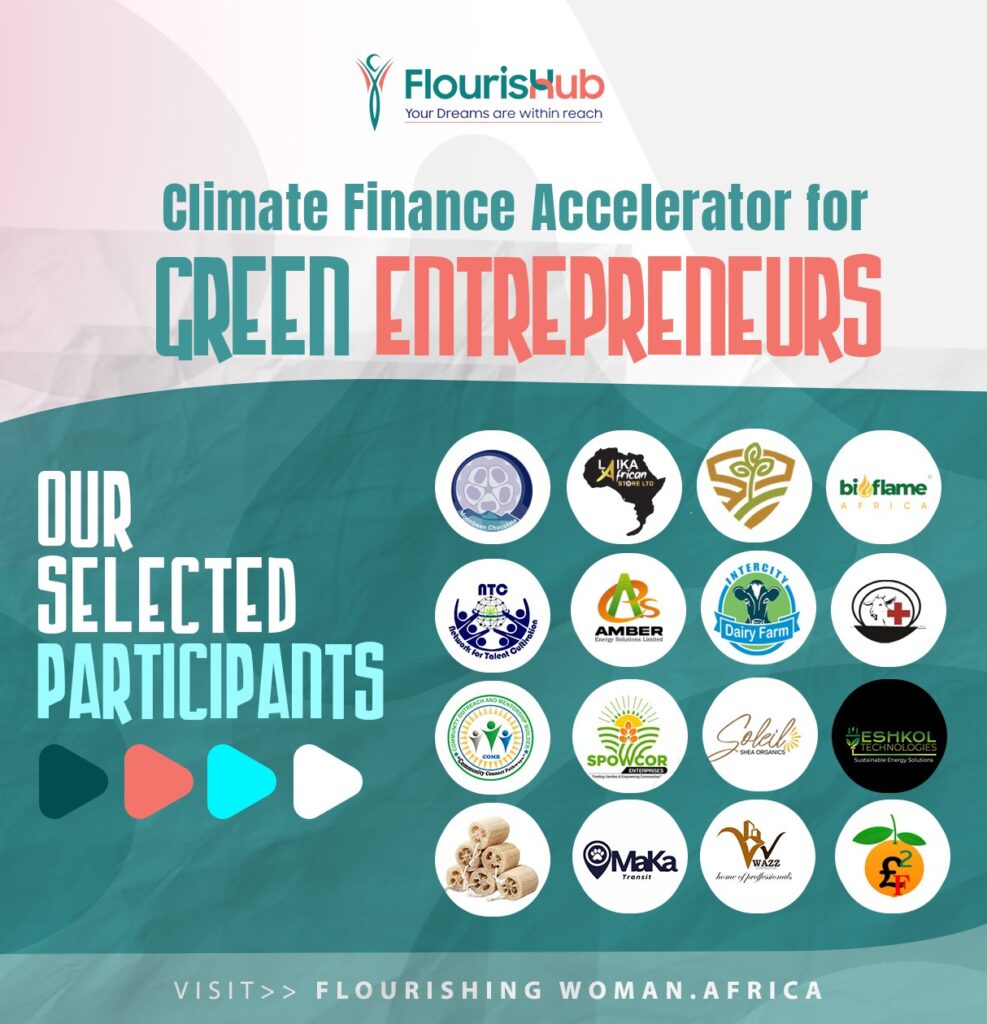
This is the thinking behind the Climate Finance Accelerator for Green Entrepreneurs by Flourish Hub. The program is designed to support founders in strengthening their sustainable business models by embedding circularity at the core of their ventures.
Participating businesses shall be guided to rethink how sustainability shows up in their product design, operations, and overall strategy, not as an afterthought, but as a foundation. The program will champion conversations that place sustainability at the centre of business models, encouraging entrepreneurs to design products and systems that are not only viable, but regenerative.
Beyond this, the accelerator will support founders in identifying and realizing revenue streams across the entire value chain. From production to post-use recovery, businesses are challenged to see waste as an opportunity, and to design models that capture value at multiple points.
The program is not just supporting individual businesses. It is contributing to a broader shift, one where sustainability is not separate from growth, but central to how growth is defined and achieved.